AI storyboard generator for film
A storyboard is cheap to change and a shot isn't. AI makes boards fast enough that there's no reason to skip them.
The short answer
An AI storyboard generator turns a script into a sequence of frames you can review before making video. Tenet, the AI film studio for Mac, draws boards on an endless canvas using character sheets, so the same people appear in each frame, and approved frames become the start frames for video shots. LTX Studio is a strong browser-based alternative.
What makes an AI storyboard useful?
A storyboard exists to answer questions before they get expensive. Who's in the shot? Where's the camera? How does this cut with the next one? A board that looks pretty but has a different hero in every frame answers none of those.
So consistency comes first. If you generate frames straight from a script, without references, you'll get a row of attractive pictures of unrelated people. Draw the cast first, and every frame after that can use them.
How do you generate a storyboard step by step?
Break down the script
List scenes, then shots. For each shot, note the size, the action, and how long it lasts.
Lock the look
Write one style sentence and decide the shape of the frame. Boards in the final look tell you more than sketches.
Draw the cast and places
One sheet per character, one clean plate per location.
Draw the frames
Generate each frame with its character and location references attached.
Review in order
Read it like a comic. If you can't follow it without notes, neither will a viewer.
How does an AI board work in Tenet?
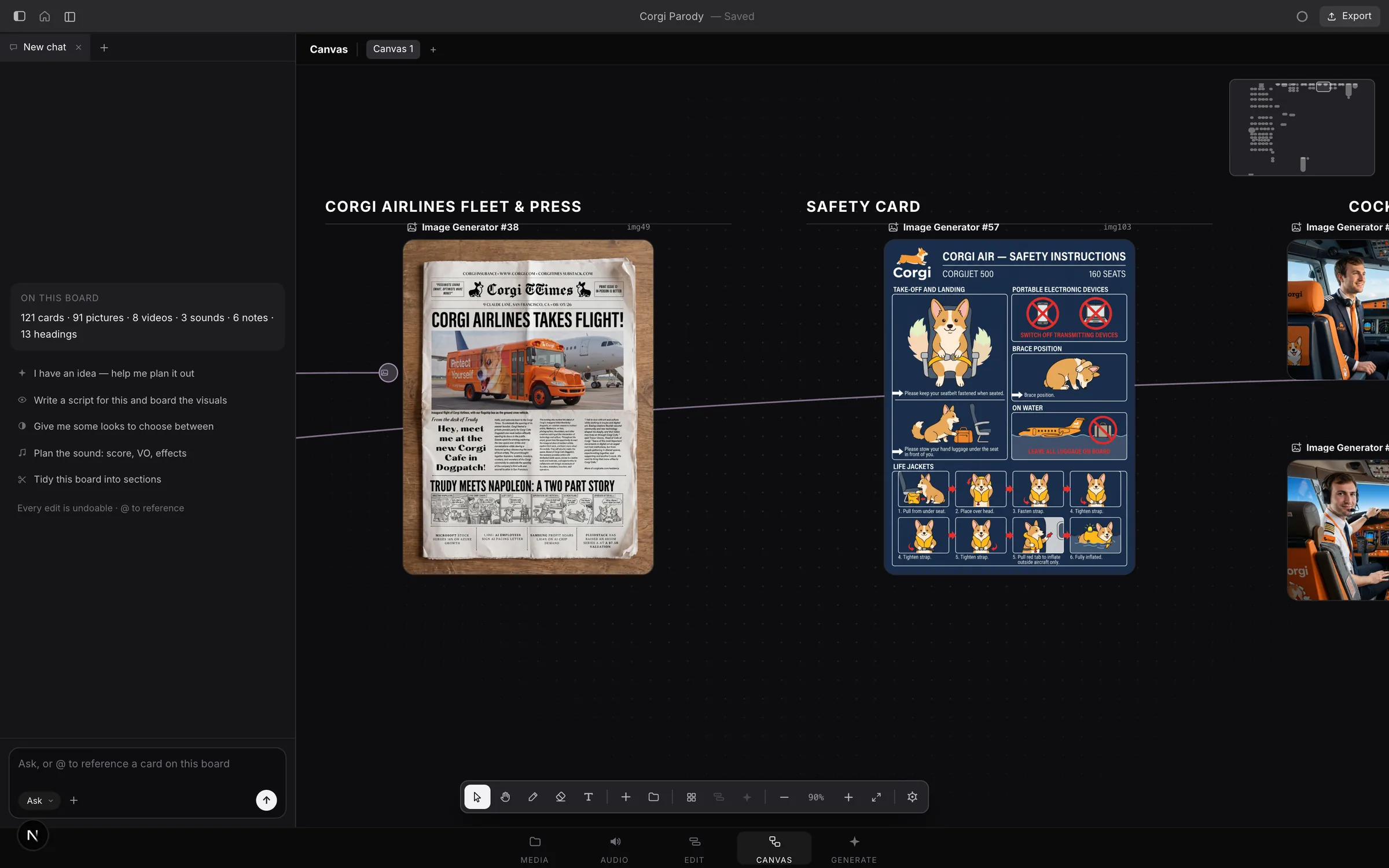
Tenet's canvas is an endless board for the whole film. Scripts, references, characters and shots sit side by side, wired together, so a shot knows its start frame, its reference and its words. The agent can lay all of this out from a sentence, and it won't generate frames for a storyboard until the cast is drawn.
Asking for a storyboard is treated as a film that stops at its pictures. It runs the same interview, plan and character boards, and then draws the frames against those boards. You can stop there and hand them to a crew, or keep going.
How do you go from board to video?
This is the biggest benefit of keeping them in one place. An approved frame becomes the first frame of its video shot. Wire a start frame, and optionally an end frame, into a video card, then write only what moves. Because the frame already holds the character, the place and the composition, the prompt can be short.
One example on Tenet's front page is simply: 'The man should delicately be playing the piano.' That one line was enough because the still did the rest of the work.
What do storyboards cost?
Very little, compared with video. An image on Nano Banana is about 6 credits, so a 20-frame board is about 120 credits, or $1.20, before redraws. Compare that with about 350 credits for a single 5-second clip on Seedance 2.5, and it's clear why testing ideas as stills pays for itself. See how much an AI film costs.
Which storyboard tools should you compare?
LTX Studio is built around storyboard-to-export in a browser. Boords and Filmustage came up in pre-production roundups for dedicated storyboarding and script breakdowns. Node canvases like Figma Weave, Flora and Melius can build frame sequences too. Tenet's advantage is that the board continues into a real timeline without any export step. It's Mac only, so it won't suit a team on Windows. Tenet vs LTX Studio.
Questions
Can AI generate a storyboard from a script?
Yes. In Tenet, drop in the script and the agent breaks it into scenes and shots, draws the cast, and then draws the frames.
How do I keep characters the same across frames?
Generate a character sheet first and use it as a reference in each frame.
Can I export storyboard frames?
The frames are images in your project. You can use them on the board or continue into video and the edit.
Is a Tenet storyboard free?
The app and the canvas are free. Generating images uses credits, about 6 credits an image on Nano Banana.